

Launch Tech Company Limited (2488.HK; “Launch Tech”), with a market cap of USD 362 million, is a 34-year-old Shenzhen company that owns one of the two leading global brands in automotive diagnostic equipment, the X-431 family. It earns roughly 28% ROE at a ~47% gross margin, holds net cash, returns most of its free cash flow to shareholders, and trades at about 7× trailing P/E with a ~12% dividend yield; roughly half of the multiple its larger domestic rival Autel Intelligent Technology Corp Limited (688208.SS; “Autel”) commands. The market’s verdict, encoded in that multiple, is that this is a plateaued Chinese hardware exporter in a decoupling world, run for cash, with its growth behind it.
Reverse-engineering the recurring, yet undisclosed, economics of Launch Tech, an under-monetized installed-base franchise emerges, with software, services, and data now contributing a roughly 11% (and growing) share of revenue. Launch appears to be shifting toward server-side offerings that are harder for the grey market to replicate, though China export risk remains real.
The key question: does the single-digit multiple reflect a melting hardware business, or overlook a recurring-revenue model still buried inside it?
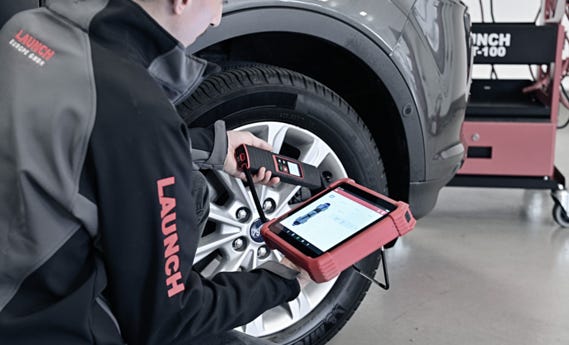
From a Shenzhen software shop to the world, how the business has evolved since IPO
When Launch Tech listed in Hong Kong in 2002, at HKD 0.72 p/share, raising just HKD 65 million (USD 8.3 million) net against a HKD 317 million (USD 40.4 million) market cap, it was sold as a pure bet on China’s car boom. The prospectus showed that 79–84% of revenue came from the PRC, while the US contributed just 0.6–2.1%. The thesis was simple: China was joining the global economy, car ownership was set to surge, and Launch would ride that growth.
Twenty-four years later, the business has inverted. In FY25, about 73% of revenue came from overseas markets, including roughly one million annual active users in the US. Overseas sales are now the growth engine and the main source of risk, exposed to tariffs, export controls, and decoupling. Meanwhile, the domestic business that once defined Launch has become the mature, more competitive leg.
