

In 2023, we published a four-part trip report documenting Russia’s post-sanctions adjustments, and found aviation fleet cannibalization, Dobry Kola taking 34% of the cola market within a year of Coca Cola HBC (CCH.L) leaving, and 161 million Mir cards in issue.


Three years on after our trip notes, investing conditions have not improved and the market got cheaper anyway. Mispricing is no longer the interesting part. The key question to answer now is what is a claim on a Russian business worth to the people who can still legally hold one?
This two-part series is built on conversations coming out of a summer of work and travel across Russia, Central Asia and the UAE. During on-the-ground discussions in Moscow, insights emerged across a wide range of market participants including local corporate advisors, cross-border tech vendors, logistics fixers managing regional trade routes, and passing conversations with young Muscovites. The most useful part of being there was testing the gap between what people claimed against what the public data and records could support. We use conditional title as a pricing term, meaning how investors treat legal risk when they set a discount. The material here comes from public filings, official statements and published data, and what we add is the assembly and arithmetic of the discount.
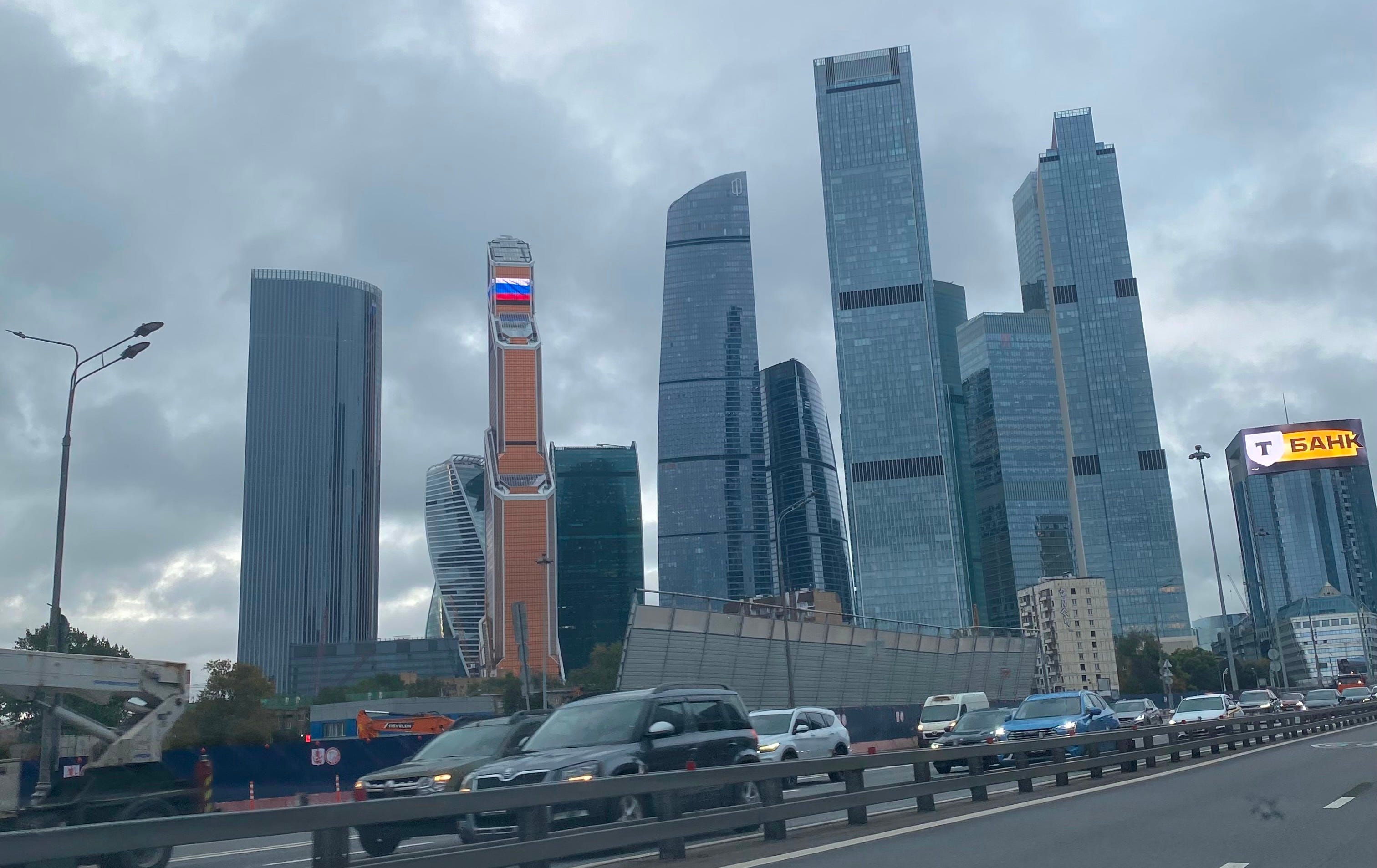
A throwaway line over dinner
In conversations with local corporate advisors in Moscow covering domestic M&A, one line about a Russian food delivery startup went past in a few seconds but stuck, because it’s the kind of claim that’s either a scandal or a misunderstanding.
“The local narrative around early-stage liquidity was that Yandex muscled their way into a crazy deal where the Foodfox founders walked away with USD 500,000.”
Prevailing sentiment across Moscow venture circles
In Russia, any surprising market move is rarely chalked up to simple business. In our conversations, a common reflex was to look for the secret orchestrator, state connection, or hidden hand behind the curtain. The implication was that the founders had been squeezed out by a buyer with more than commercial leverage. We decided to dig into public filings and available information to see whether there was anything behind it.
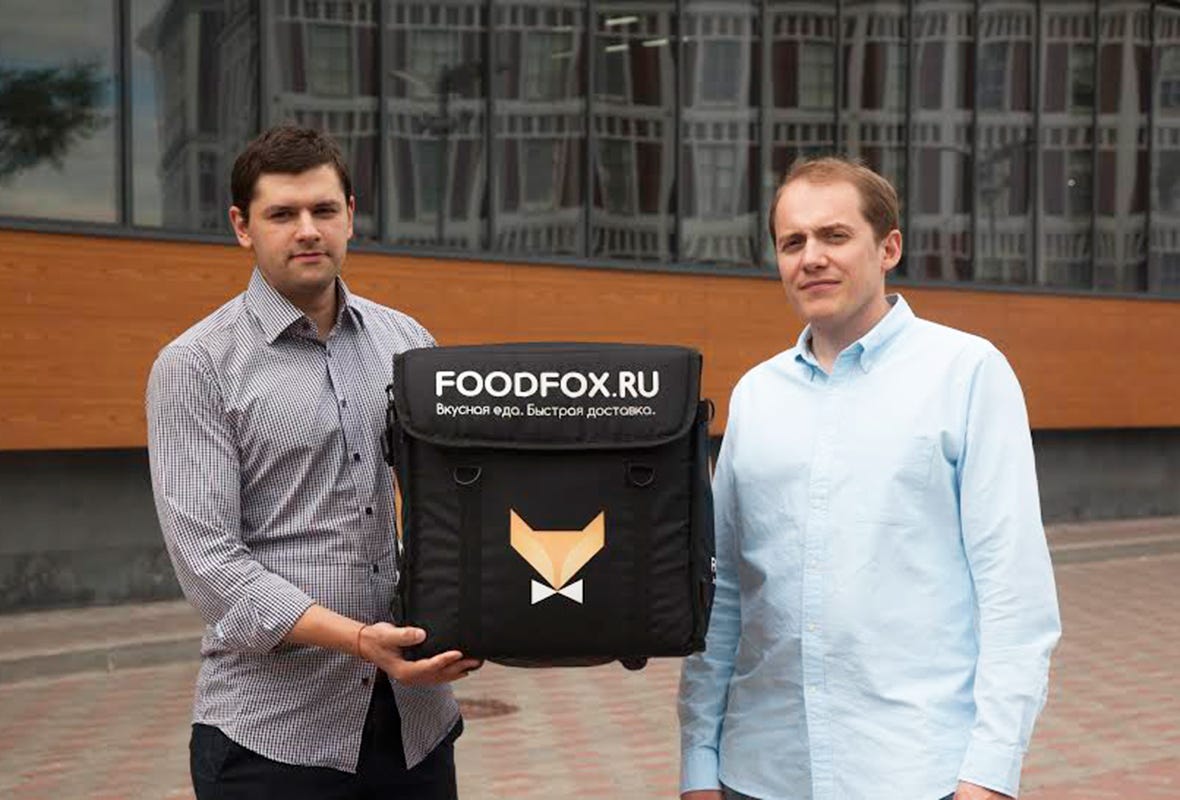
Sergey Polissar and Maxim Firsov, both ex-Lamoda, launched Foodfox in April 2016. The product was effectively a Deliveroo clone. Foodfox owned its courier layer, with in-house riders working a 2–2.5km radius, live tracking, no minimum order, while the incumbent aggregator at the time simply passed orders to restaurants’ own drivers.
They raised about USD 1 million in July 2016 and USD 5 million in June 2017; USD 6 million in total, plus convertible debt in the stack, against a company that was small and bleeding. Yandex’s (YDEX.MM; YNDX.O (delisted); “Yandex”) own pro-forma disclosure in its FY17 Form 20-F puts Foodfox’s full-year revenue at RUB 104 million (USD 1.8 million) against a net loss of RUB 409 million (~USD 7.1 million). Foodfox was burning roughly 4x its revenue. By mid-2017, it had about 1,000 restaurants vs its closest peer Delivery Club, which had 5,200 and roughly 80% of the market. An industry source told RBC at the time that Foodfox had “slowed its development and needed money, but because of poor indicators it was difficult to find an investor. In the end there was no choice but to sell to a strategic buyer.”
As of 22 December 2017 close, Foodfox was sold to Yandex on the following terms:

Goodwill alone at USD 11.1 million exceeded the entire consideration. Yandex booked almost nothing as transferable asset value, and said so in its own words: “expected synergies and the assembled workforce.” That is the accounting way of saying it bought a team. The deferred payment was owed to Foodfox’s former shareholders and convertible debt holders. With debt sitting ahead of the equity stack, it does not leave much for the common shareholders, which is where the founders sat.
Right number, wrong villain: the preference stack
We couldn’t find any published sources that give the founders’ take. The last public ownership snapshot in June 2016 had Polissar and Firsov at 32.51% each on its pre-Series A. The arithmetic from there is not a mystery.
If we assumed a plain 1x non-participating stack, a USD 6 million of preference against USD 10.3 million exit leaves roughly USD 4.3 million of residual for common. Post-Series-A dilution puts the two founders at maybe 45–50% of that residual, or roughly USD 1 million each gross. Once you subtract the 9% of consideration deferred a year, plus structuring and tax leakage at the holding level, coupled with any participating term at or above 1x, that USD 500,000 net figure per founder sits comfortably inside it.
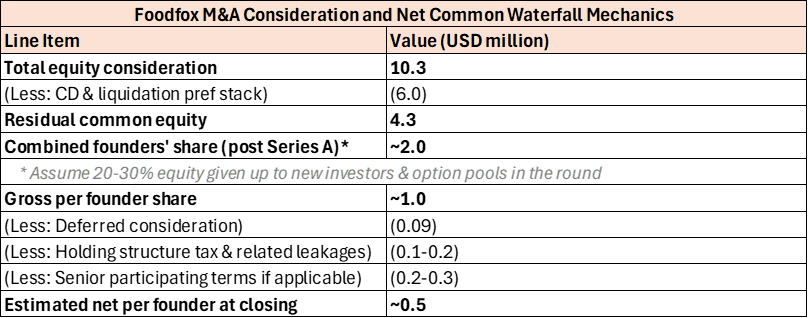
Although the arithmetic makes sense, the explanation doesn’t quite hold up. The founders held common stock under a preference stack, and the value had already been set in the June 2017 term sheet months before anyone sat down with Yandex. What sharpened the timing was the buyer’s alternative, because Yandex had agreed an Uber JV in July 2017 and the competition authority cleared it on 24 November, four days after the Foodfox news broke. That JV folded UberEats Russia into Yandex’s camp without a separate purchase, so the buyer could negotiate with a credible “we buy you, or we build on UberEats.”
Seven weeks after the Foodfox shareholders cashed out at a USD 10.3 million mark, the entity was contributed into MLU B.V. at a USD 3.73 billion valuation. The ~3.8% held by employees across the whole joint venture was worth around USD 145 million, roughly 14x what Foodfox had just been sold for. That value was created after the sale. Both founders announced their exit from Yandex.Eda in February 2020.
So the local story inferred a predator and a hidden hand, while the filing suggests two private parties did an ordinary distressed deal. Reading between the lines, it was the market structure, coupled with the buyer’s leverage, that made this transaction the only viable option.
Foodfox could not raise because there was no domestic growth-capital pool willing to fund a loss-making consumer platform to scale, and no foreign one that would price the political tail. By PwC and RVC’s count, the entire Russian venture market put about USD 244 million to work in 2017 across every sector.
In deeper market, a company burning 4x revenue with a genuinely differentiated dispatch layer could either raise at a premium or if worse, a punitive down round. Here, it sold to the one strategic buyer, in the week that buyer’s alternative became free.
Exit-value constraints on Russian capital
What constrained the start-up was the absence of anyone willing to fund it past USD 10 million. Yandex in 2017 was a NASDAQ-listed, Dutch-domiciled company whose most sensitive shareholder issue was an excess of foreign ownership. While the state did not own the company, it had held a veto over it since 2009 through a golden share parked with Sberbank (SBER.MM).
Exit values are set at the top of the market. The connection to Foodfox runs through the exit. A growth investor funds a loss-making platform on what it is worth if it works, and that depends on what the exit can pay. For a 2017 underwriter of a Russian consumer platform, that reference set already included VKontakte’s (VKCO.MM) change of control in 2014, while Yandex and Wildberries later added to it. In our view, that reference set is a large part of why the growth capital was not there in 2017, and is not there now.
The four public cases illustrating the pattern are:
VKontakte (VKCO.MM), 2014: Durov, who has said he refused official requests for user data, sells his 12% in January. In April, he is removed as CEO and leaves the country. Mail.ru owns 100% by September.
Yandex, 2019: Yandex moved its golden share previously held by state-owned Sberbank (SBER.MM) to a “Public Interest Foundation”, with blocking rights over 10%+ stakes, IP and data deals, and management.
Wildberries, 2024: Russia’s largest online retailer merges with an outdoor-advertising group after a highly publicized corporate dispute saga, which a co-founder characterized the deal as a hostile takeover.
Yandex, 2024: The Russian business is sold to a domestic consortium for ~USD 5.2 billion, reported to be at roughly half market value. The Dutch remainder renames itself Nebius Group (NBIS.O).
For an investor, what matters is the scale of title risk the market has to work with. Beneath the headline cases sits a much larger volume of court activity. By the count of law firm Nektorov, Saveliev & Partners (NSP), assets worth RUB 3.12 trillion (~USD 37 billion) were transferred to state ownership in 2025, 4.5x the 2024 figure. The Prosecutor General gives a similar order of magnitude for the anti-corruption track alone. Courts upheld claims worth more than RUB 3 trillion (~USD 36 billion) across 2025 and in H126.
The legal routes reported include challenges to 1990s privatizations, the treatment of owners with foreign passports as foreign investors in strategic assets, and anti-corruption forfeiture claims to which, in several cases, courts have applied no limitation period.
The official position matters for pricing because it sets the boundary of what investors expect to happen next. For now, none of these measures amounts to a revision of privatization. Officials describe the cases as anti-corruption and national-security enforcement. At the RSPP congress in April 2024, Putin said privatization results would not be revisited and that claims should be limited to owners whose actions harm national security. The ten-year limitation period on privatization challenges introduced in 2026 was a step in that direction, but it leaves other routes open. For an investor, the practical implication is that business size does not by itself guarantee title.
The re-privatization question
If titles can be restored, the discount should narrow. The first test is whether a title that has been taken can be sold at market value. On 11 September 2026, Vedomosti reported that the government had listed two IT companies recently transferred to state ownership, Inforion (Инфорион) and Status Compliance (Статус комплайнс), for sale, marking the Russian tech sector’s first attempted re-privatization. Both companies had been transferred to the state five months earlier under an anti-corruption claim brought against former Deputy Transport Minister Alexei Semenov.
Neither asset was struggling, nor was it a standard state target. Status Compliance’s 2025 revenue rose more than fivefold to RUB 9.59 billion (~USD 113.8 million) and net profit nearly sevenfold to RUB 1.34 billion (~USD 15.9 million). Growth of this kind makes a company visible, and visibility can make an asset strategic. Yet analysts already expect buyers to hesitate. A sale at market value would establish a price for a title of this kind. Buyers will also weigh that a title annulled once on anti-corruption grounds without a limitation period can, in principle, be challenged again.
The China comparison
Every conversation about state-linked risks in Russia eventually turns to China. Allocators often paint both markets with the same broad brush, lumping their political risks as a single bucket to be navigated.
The most frequently cited evidence of Russian state influence in tech is the Yandex golden share. Yet China has relied on a comparable instrument, known as “special management shares”, since 2016–17. These state-held stakes exist across Chinese tech in Weibo (WB.O), Douyin and Toutiao at ByteDance, Kuaishou (1024.HK), Ximalaya, Youku and UCWeb at Alibaba (9988.HK; BABA.N), and WeChat at Tencent (0700.HK; TCEHY.PK).
When a state fund acquired ByteDance’s golden share in April 2021, it secured a board seat and a say over content. In January 2023, the Cyberspace Administration’s investment arm took a similar 1% stake in an Alibaba (9988.HK; BABA.N) subsidiary. State oversight in a national tech champion is nothing new, and global allocators have long made peace with owning Chinese assets that carry one. The veto itself is common ground between Moscow and Beijing.
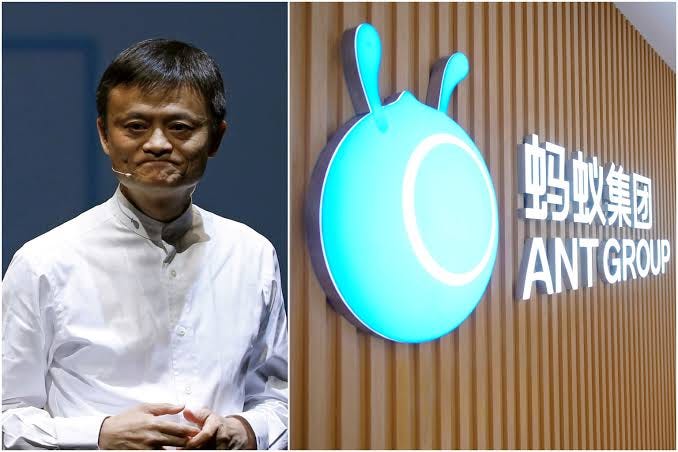
What differs for an investor is the predictability of what follows. China’s regulatory campaign against its platform companies had a clear beginning and end. It opened with the suspension of Ant Group’s IPO in November 2020, swept through the platform and tutoring sectors, and closed just as visibly when Jack Ma sat in the room as Xi chaired a private-sector symposium at the Great Hall of the People in February 2025. Three months later, the Private Economy Promotion Law took effect – 78 articles promising equal market access, fair treatment and property-rights protection. In our research, we couldn’t find comparable public bookends in Russia’s cycle. We are not aware of a public case of an owner whose assets were transferred being invited back.
In 2025, both Beijing and Moscow issued formal undertakings to reassure private capital, and the market response differed. China codified its commitment through the Private Economy Promotion Law, offering formal market-access rights. Russia’s promise was, on paper, structurally more generous. A presidential decree in July 2025 established “Ин” accounts for new foreign money, with an explicit sovereign guarantee against freezing for the marginal foreign investor. Yet capital stayed away. By June 2026, Deputy Finance Minister Ivan Chebeskov said that while accounts had been opened, no investment had yet flowed through them. Venture capital flows show the same divergence:

Russian VC is tracking toward roughly USD 60 million for 2026. Chinese VC investment hit USD 35.1 billion in Q226 alone, the highest quarter since 2021. A single quarter of Chinese venture funding is nearly 600x Russia’s projected total for the year. The two data sets are compiled differently, but not differently enough to close a gap of that size. Because China’s economy is roughly 8x the size of Russia’s, macroeconomic scale explains almost none of this disparity.
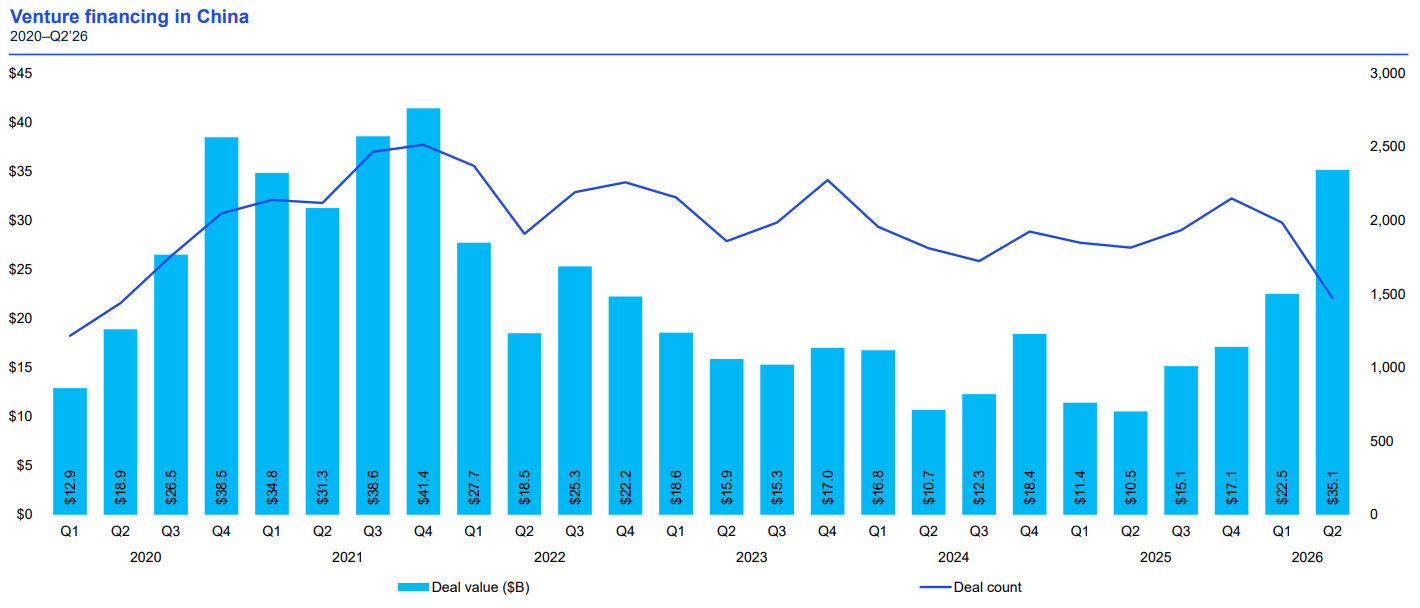
What matters for pricing is what can be underwritten in advance. Tough rules published before the fact can be priced. Rulings on historic transactions, where the standard may only become clear when the case is heard, sometimes decades after a 1990s privatization, are harder. Russia offered the more explicit paper guarantee and has drawn limited institutional interest. In our view, the market is likely still pricing the transfer record.
What the buyer holds
Put the transfer record alongside the legal exceptions and the nature of the asset becomes clearer. The cash flows generated by a Russian business are real, and so is the heavy market discount. What is on offer is a conditional claim on those earnings. That claim can be revisited by a Russian court over a thirty-year-old transaction, under rules whose limits are not yet settled. The venture capital figures are the market’s own assessment of that reality.
Whether that same discount shows up in Muscovites’ savings, advisory fees, and in the cost of cross-border settlement is the subject of Part 2.
Disclaimer: This research piece above is for informational, entertainment, educational, and/or study or research purposes only. The information contained herein or discussed does not, should not, and cannot be construed as or relied upon and, for all intents and purposes, does not constitute or provide professional financial, investment, or any other form of advice. This research does not and should not be construed as an offer to sell or the solicitation of an offer to buy any securities or any other financial instruments in any jurisdiction, including where such actions are illegal. This research is not intended for publication in jurisdictions where it would violate laws. The research does not consider individual investment objectives or financial positions and merely expresses the opinions of its authors. Any investment involves taking substantial risks, including (but not limited to) the complete loss of capital. Every investor has different strategies, risk tolerances, and time frames. You are advised to perform your own independent checks, research, or study, and you should consult a licensed professional before making any investment decisions. The assumptions and parameters discussed or used are not the only reasonable ones, and no guarantee is given for their accuracy, completeness, or reasonableness. No promise is made that any indicative performance return will be achieved. The research is derived from public information sourced by Pyramids and Pagodas. No representation or warranty is given for the reliability, completeness, timeliness, accuracy, or fitness of this research, nor is any responsibility or liability accepted for any loss or damage. The authors (Pyramids and Pagodas) shall in no event be held liable to any party for any direct, indirect, punitive, special, incidental, or consequential damages arising directly or indirectly from the use of any of this material.